NHS Grampian – Foresterhill Health Campus
NHS Grampian has set out a pathway to net zero operational emissions by 2040. As part of that it tendered a feasibility study to decarbonise the heating system of Foresterhill Health Campus in Aberdeen, the largest and most energy-consumptive hospital campus in the north-east Grampians. The study reviewed the available renewable technologies and compared them with the hospital’s heating demand to determine the best solution.
There were two core challenges. The campus’ heat is supplied by a high-pressure heat distribution network, and meeting the temperatures required for steam results in a 90 per cent drop in the efficiency of a geothermal system. Running the hospital at lower temperatures, with higher heating efficiency, is only possible if the heating infrastructure is improved to modern standard.
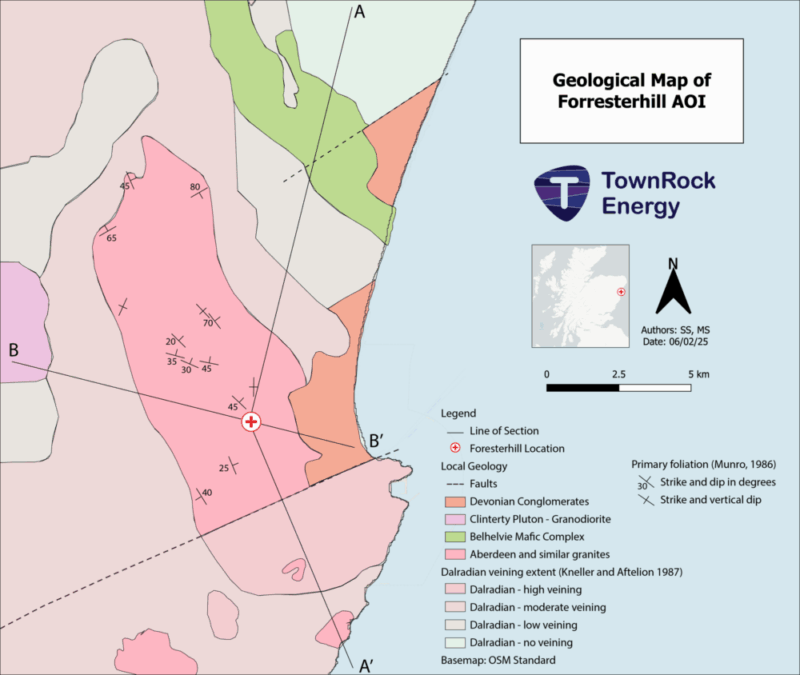
The second challenge was that there was very little data to inform our understanding of conditions below ground, so the temperature forecasts and techno-economic modelling results carry large margins of error. For example, evidence suggests the ground in the northern UK was cooled during the last ice age, but no boreholes have been drilled to the depths required to test the theory, which leaves a large range of temperature forecasts.
We investigated three deep geothermal technologies that would meet up to 90 per cent of the hospital’s baseload heat demand. This meant most of the heat load could be supplied while maintaining the most efficient geothermal system, ignoring the high-temperature steam distribution system.
Once the ideal geothermal system was designed, we carried it through our techno-economic modelling process. We also proposed an exploration programme ahead of developing any geothermal system, to help prove that the resource could be developed. Both the exploration and production well designs were costed using experienced drilling engineers. Using the well costs, the final financial model was produced by forecasting energy revenue through the project life. The final business case was delivered with consideration for project risk assessment, stakeholder engagement and the regulatory framework.
The optimal geothermal design was an engineered geothermal system, known as EGS. Our temperature modelling forecast a maximum potential bottom hole temperature of 160 °C at 5 km depth. A depth range of 3.5–5 km was modelled, with flow temperatures of 75–112 °C. Under these conditions a successful EGS would be capable of delivering 8.5–11.1 MW at a capital cost of £40m–£60m.
Our feasibility study looking at utilising the granite below Aberdeen as a heat source for the Foresterhill Campus went without issues. Despite the tight deadline for the project the team at TownRock were able to deliver on time and on budget with a fully worked through feasibility study looking at three deep geothermal technologies. Their experience in previous projects and contacts within the industry were invaluable in ensuring we were looking at the most up to date data and solutions.
Every project started as a question about what was underneath a building. Ask us the same question about yours.