

Across the UK (and the World!), the ground beneath our feet holds a continuous source of low-carbon heat. This geothermal heat doesn’t depend on the weather and can deliver stable temperatures year-round providing a predictable and resilient price. The low spatial footprint and high generating efficiencies of geothermal systems are rapidly gaining interest as individuals, organisations and businesses are looking to decarbonise.
This post aims to give a simple overview of what geothermal energy is, the different types of geothermal system and how to determine if geothermal energy could work to help decarbonise heating (and cooling) at your site.
In this guide
The Science in Plain English
In simple terms, geothermal energy is energy stored in the form of heat, beneath the surface of the earth1. The key principle to understand is that the deeper you go beneath the Earth’s surface, the warmer it gets. In fact, in the centre of the Earth, temperatures reach up to 6000 °C!
This heat, a result of heat captured during the formation of the Earth and of the ongoing decay of radioactive elements, is radiating out from the Earth’s core to the surface. This produces a geothermal gradient, which is the rate at which temperature increases with depth. In the UK, the average gradient is around 26 – 30 °C per kilometre, though this varies depending on local geology. This means that if the ground temperature at the surface is around 10 – 12 °C, at a kilometre down, subsurface temperatures can approach 40 °C. At greater depths, if we can target the right rock formations, we can obtain temperatures over 100 °C!
Geothermal systems can be used to extract this heat for use at surface. Whether we are targeting 20 °C in the shallow subsurface, or much higher temperatures at several kilometres depth, the principle of geothermal energy is the same: providing energy in the form of heat.
The Different Types of Geothermal Systems
Geothermal energy isn’t a single technology. In fact, there are multiple technologies, all with the same objective, bringing heat from underground to the surface where it can be used.
Geothermal technologies can be split into three main types:
- Shallow geothermal systems
- Deep geothermal systems
- Emerging geothermal systems
Shallow geothermal systems
As the name suggests, shallow geothermal systems are those that extend to shallow depths in the subsurface. Whilst there is no industry-wide depth limit for shallow geothermal systems, the boundary is often considered to be 500 m below ground level2.
At these depths, the ground is typically between 10 and 20 °C, meaning a heat pump is usually used to boost this to a temperature suitable for heating homes and businesses.
Shallow geothermal systems can then be categorised based on whether they are “closed” or “open”. The difference between these sub-categories is whether they are abstracting groundwater from the subsurface. Closed systems do not, they rely on conduction of heat from the rock into boreholes circulating clean fluid. Open systems take warm groundwater from the subsurface to surface, where heat can be transferred to a heat pump, before the cooled groundwater is reinjected back into the ground.
Shallow closed-loop
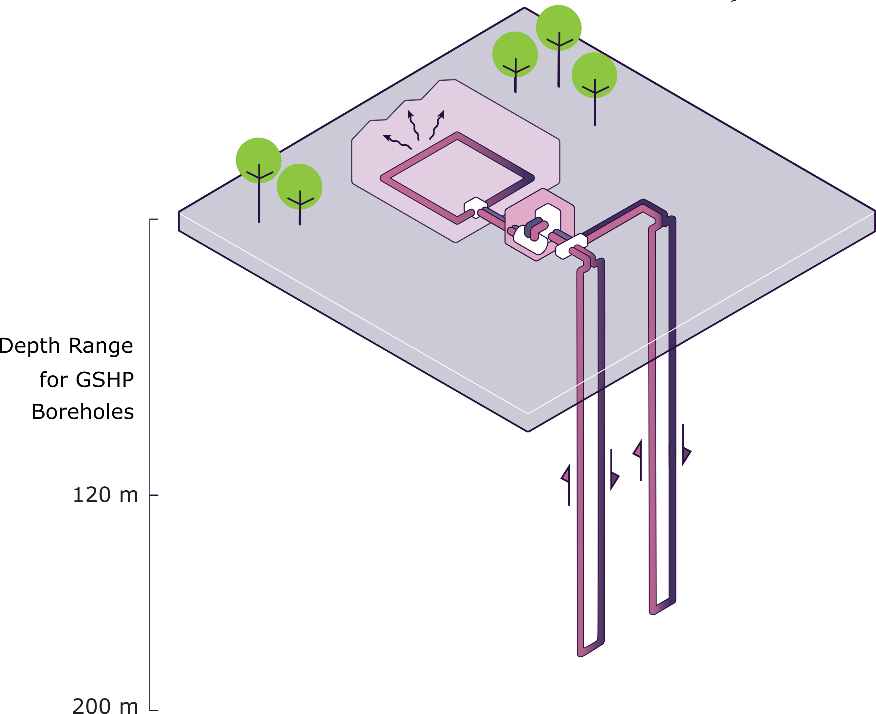
These are the most common type of geothermal system in the UK, typically called Ground Source Heat Pumps (GSHPs). Closed-loop GSHP systems consist of a collection (“array”) of 120–200 m shallow vertical boreholes into which plastic U-tube pipes are installed. Fluid is circulated through the U-tubes to extract heat from the ground before passing through a heat pump.
Shallow open-loop
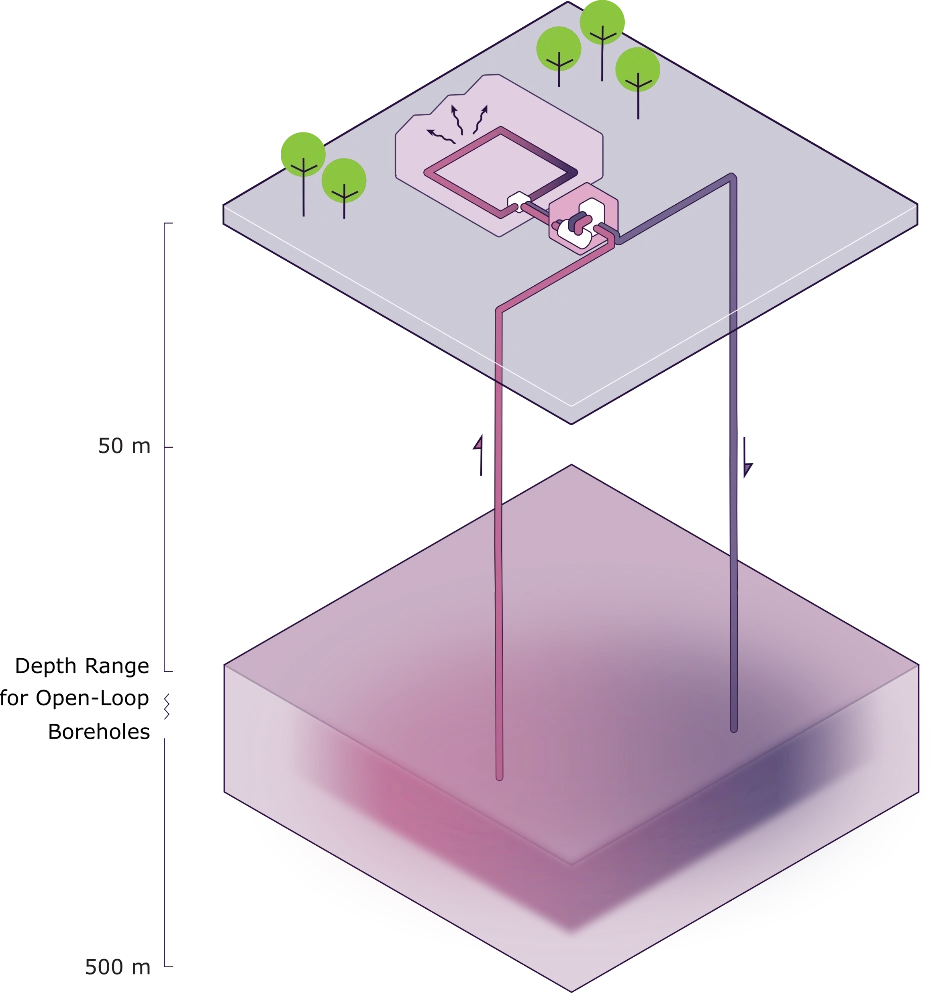
Shallow open-loop systems abstract groundwater from water-bearing permeable rock (“aquifers”). These systems comprise of at least two vertical boreholes: one to abstract water from the subsurface, and one to discharge cooled water back into the subsurface. The efficiency of an open-loop system is typically greater than a closed-loop system per borehole because heat is extracted from flowing groundwater.
Shallow mine water
Mine water systems are another type of open-loop system. Instead of abstracting groundwater from geological aquifers, these systems abstract groundwater from an anthropogenic “aquifer”: abandoned, flooded mine workings. As for standard open-loop systems, at least one abstraction and one discharge borehole are required. These must be partially connected underground by the workings.
Abandoned mines are location dependent, but are widespread beneath major population centres across the UK. Where mines are present, this type of shallow system can benefit from the large void spaces and extensive fracturing, which often results in high flow rates and therefore heat output.

Deep geothermal systems
Below the shallow geothermal 500 m cut off, geothermal systems fall into the “deep” category. As these systems extend to depths greater than 500 m into the subsurface, they can access higher temperatures at depth. This can mean that deep geothermal systems can be “direct use” i.e. they do not require a heat pump to deliver heat to the customer. This is dependent on the subsurface conditions (geology and geothermal gradient) and the temperature required by the customer.
Due to the higher source temperature, these systems can often provide more heat than shallow systems. This means they are well suited to meeting large demands, such as that required by hospitals or district heat networks.
Similarly to shallow systems, deep geothermal systems can be broken down into closed- and open-loop subcategories:
Deep open-loop
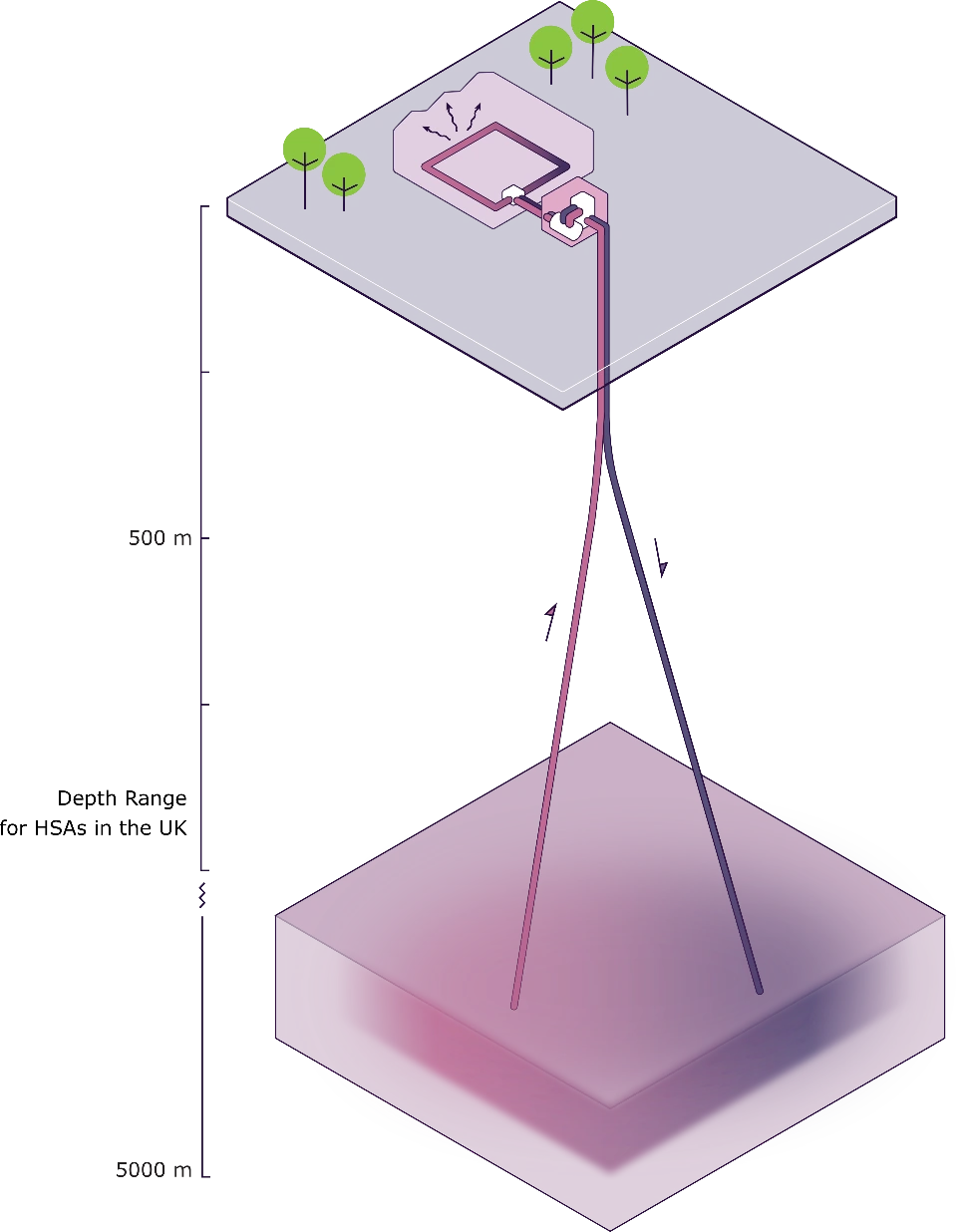
Also referred to as Hot Sedimentary Aquifers, these deep open-loop systems abstract groundwater from deep (>500 m) permeable aquifers, allowing them to access higher temperatures. Depending on the heat demand, a heat pump may not be required. This enables a much more efficient system able to extract large amounts of heat energy.
Deep coaxial
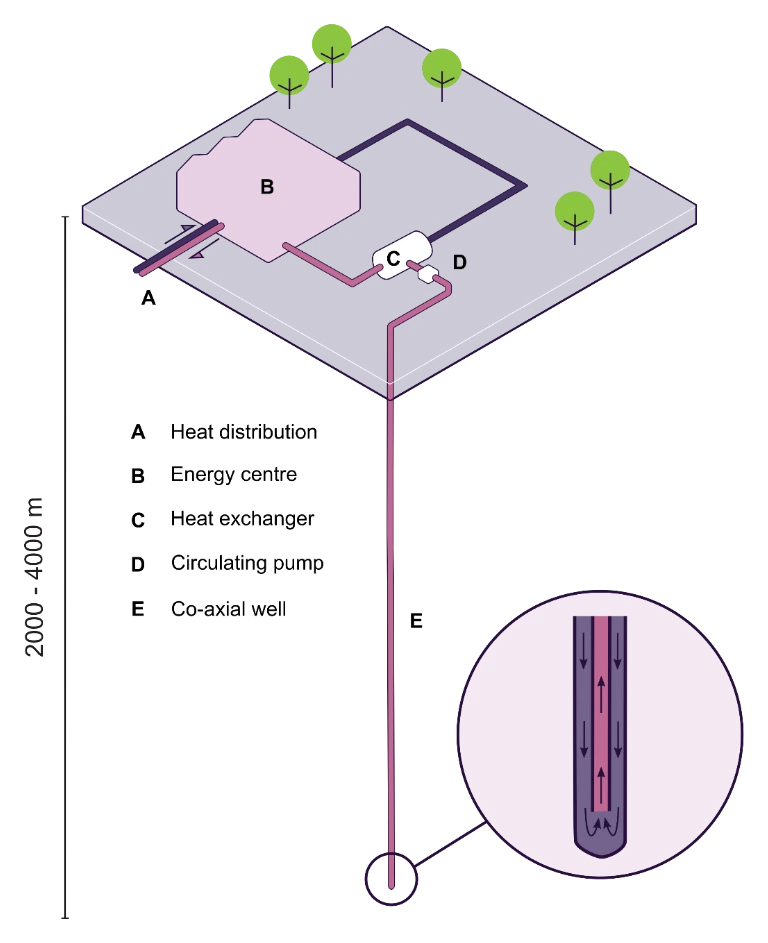
Closed-loop systems with a traditional U-tube become more difficult to install at greater depths. As such, for deeper closed-loop systems, a coaxial configuration is typically used. These systems circulate cold water down an outer tube, where it is heated by the surrounding rock mass. It is then returned through the thermally insulated central tube.
These systems are particularly attractive in granites and metamorphic rocks where there is insufficient groundwater flow to install an open-loop system, but the elevated geothermal gradients allow for reasonable heat production rates.
Emerging geothermal systems
As the geothermal industry continues to mature, novel technologies are allowing heat to be abstracted from rocks at greater depths than previously achieved.
At the moment, there are two key emerging deep technologies in the geothermal space:
Enhanced Geothermal Systems (EGS)
Engineered (or Enhanced) Geothermal Systems (EGS) use a variety of modern and safe rock stimulation technologies to create artificial permeability in deep, hot rocks with minimal or no natural fracturing. Typically, two or more boreholes are drilled and connected by hydraulic (or other suitable electrical, chemical or mechanical) stimulation techniques. Water is then circulated through the system, resulting in high heat outputs and temperatures. EGS are at a relatively early technology readiness stage, however rapid technology development is underway, mainly in the US.

Advanced Geothermal Systems (AGS)
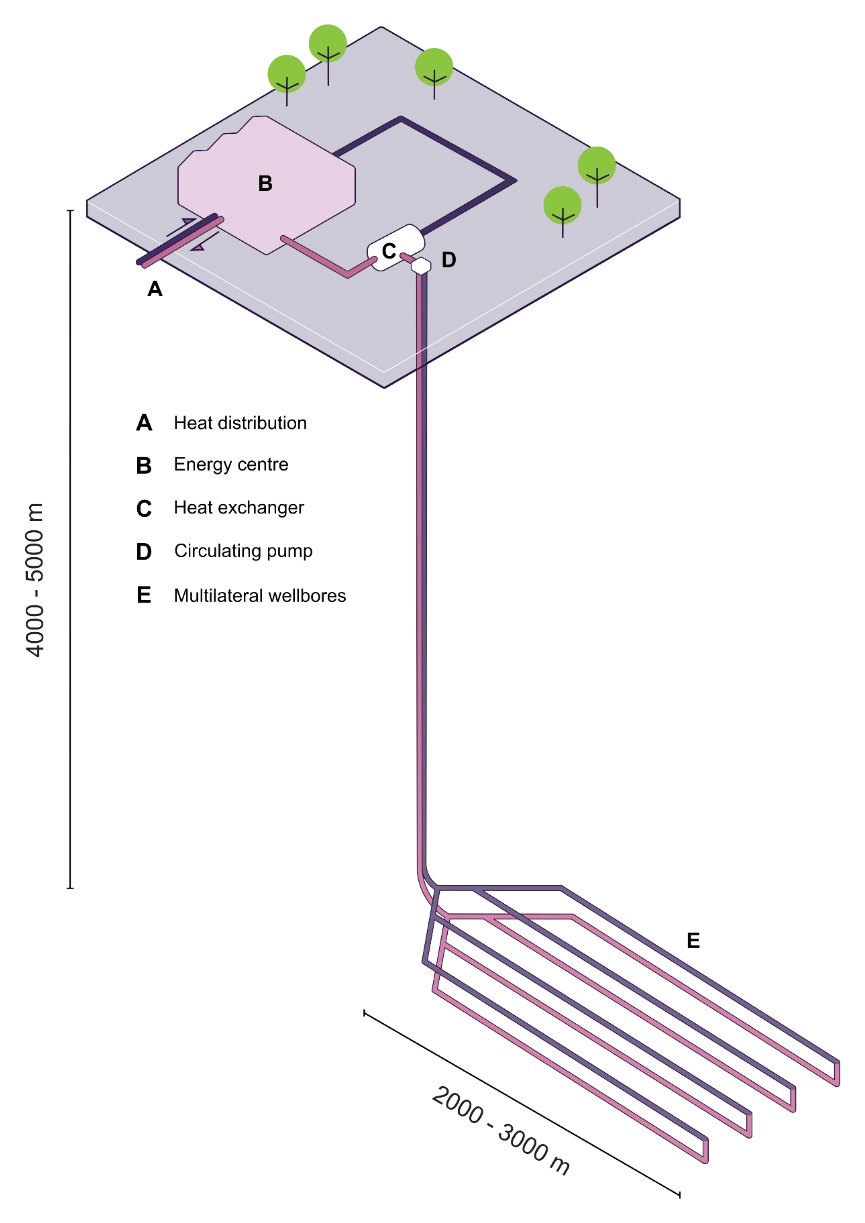
Advanced Geothermal Systems (AGS) are a reservoir independent technology (closed-loop) which use an array of interconnected multilateral wells to extract heat from the surrounding rock mass via conduction. Fluid is circulated through the vertical “motherbores” and around the multilateral sections to extract large quantities of heat from the subsurface. With only one demonstrator system in the early stages of operation, AGS are also at an early technology readiness stage.
Is Geothermal Right for Your Site?
With lots of options for geothermal systems – how do you know which one may be suitable for your site? Knowing which is best depends on three factors:
Geology beneath your site
Understanding the geology beneath the site allows you to know which technologies are possible. If there are no permeable aquifers or mine workings beneath your site, this rules out the possibility of open-loop systems. Understanding depth and properties of the geological units beneath the site will then inform the design of any possible systems. This kind of analysis can be done by geologists, who will use information from geological maps, nearby wells and potentially other sources such as seismic data, to start building up a picture of the subsurface beneath the site.
Land availability at surface
Land availability at surface will also impact the system type selection. Whilst the surface footprint of installed geothermal systems is minimal, boreholes do need to be drilled in open spaces, such as car parks. How much land is available will impact whether a closed-loop system (typically with a greater number of boreholes) or open-loop system is better suited.
Site heat demand
Finally, the site heat demand helps define not only what type of geothermal system is best suited, but also its optimal size. Smaller buildings with a modest heating demand may be better suited to a cheaper, shallow closed-loop system compared with a district heat network which may need megawatts of continuous heat all year round.
All three factors need consideration together to determine which geothermal solutions may best suit a site, which is where a SCOPE study comes in. We assess available data to develop the subsurface understanding and the heating (and cooling) demand of the site. Factoring in the space available and any constraints at surface, we can then give clear recommendations on which technologies suit your specific site.
Next Steps
We hope this post highlights that geothermal energy is a suite of proven technologies, adaptable based on the building heating (and cooling) demand. With operational examples across the UK spanning individual homes with ground source heat pumps, to district-scale networks drawing on mine water or deep open-loop systems.
Geothermal isn’t a one-size-fits-all technology, with the best suited option depending on the geology, land availability and heat demand at your specific site. Assessing these factors at an early stage is therefore crucial, and where a dedicated SCOPE study can make the difference between a scheme that delivers for decades and one that never quite gets off the ground.
If you are curious about what type of geothermal system could work for your site, we’d be happy to help you find out. Reach out to talk to our team about whether geothermal is right for your site.
References
- Geothermal energy, British Geological Survey [online]. https://www.bgs.ac.uk/geology-projects/geothermal-energy/
- Geothermal technologies, British Geological Survey [online]. https://www.bgs.ac.uk/geology-projects/geothermal-energy/geothermal-technologies/