

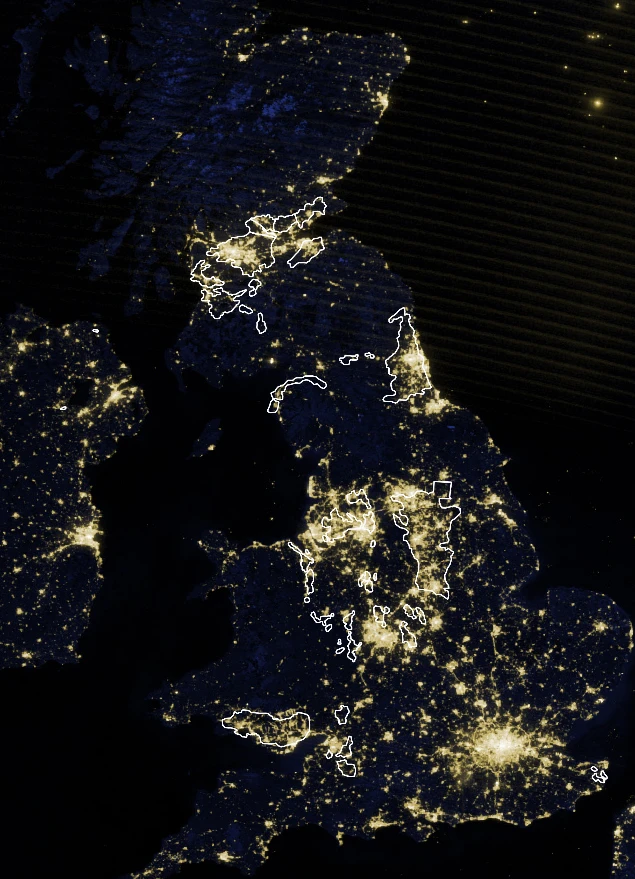
Here’s a satellite image of the UK at night – if ever we needed a reminder of how our energy demand never sleeps. The white shapes show where hundreds of years of coal mining activity have put places like Glasgow, Newcastle, Yorkshire and the South Wales valleys on the map. 25% of the population, almost 20 million people, live and work in these areas.
What you may not realise is the potential for the very mines that built these areas to now supply much of their energy. When mining stopped, the void space that was created became flooded with billions of litres of water that has been warmed naturally by the earth, that can now be used to heat homes and businesses. By drilling boreholes into the mine workings, we can extract this warm water, take out some heat to be upgraded by high efficiency heat pumps, and reinject the cooled water to be reheated by the Earth.
This is not a blue sky technology – there are operational examples in the UK now. Find out more about the three operational schemes supplying heat to the city of Gateshead in our case studies on the Abbotsford Road and Nest Road mine water geothermal systems, and in the Mining Remediation Authority’s overview of the Gateshead mine water energy scheme.
Region-by-region analysis
NE England
The scale of mining activity in the Northeast was such that we now even have a phrase in common language. “Taking coals to Newcastle” would be foolhardy given the volume of coal exports peaked at 20 million tonnes per year in the 1930s. This has left vast areas of now flooded workings beneath densely populated centres of Tyne and Wear as well as Durham and Northumberland. Aptly, this is now one of the pioneering centres of mine water heating in the world. 3 operational schemes provide a combined capacity of nearly 10MW of heating to homes and businesses in Gateshead, bringing new life into the heart of a former mining community.
Yorkshire and East Midlands
Home to the largest coal mining activity ever seen in the UK, the superpits of Yorkshire and the East Midlands used industrial technology to go bigger and deeper than ever before. This is great news for mine water heating as it means larger flows of warmer water. As such, this is a key area of interest for mine water development with the potential to provide thermal energy to cities like Sheffield, Rotherham and Nottingham.
South Wales
The South Wales Coalfield spans right the way from Newport to Pembrokeshire through the Welsh Valleys like a giant ice cream scoop. This was the beating heart of the industrial revolution supplying steam coal around the world. Already this is now being explored for its heating potential, with a pilot scheme in Carmarthenshire supplying low carbon heating to a nearby warehouse and office, paving the way for several other schemes across the valleys. If you’re in the area, be sure to visit the Big Pit at Blaenavon UNESCO world heritage site which includes an underground tour with miners who worked the pits in the 1970s and 80s.
Scottish Central Belt
Almost ¾ of people in Scotland live in the Central Belt, another region that powered the industrial revolution through the great coalfields of the Clyde, Ayrshire and the Lothians. This is another area with vast potential and home to the first two ever mine water schemes, providing invaluable lessons for future development. Pioneering research is ongoing to understand how Scottish mines can be used to heat our homes while simultaneously providing low carbon cooling to data centres, a concept which has massive importance in today’s AI-thirsty society.
In summary, the UK’s coalfields hold a genuine, largely untapped geothermal opportunity, and it is more widespread than most people realise. You can browse our work across the UK and internationally, or get in touch today to find out if your town sits on geothermal potential!