
What, why, where and how
Geothermal Energy in the UK
TownRock Energy is an award-winning geothermal energy consultancy based in Edinburgh, Scotland. We specialise in all aspects of the UK’s geothermal resource.
For renewable heat look beneath your feet
Reviewed by David Townsend, CEO & Founder
6000°C
Earth’s core is 6000°C
30–50°C
In the UK the temperature at 1km is typically 30–50°C and increases linearly with depth
45%
of UK energy use is heating
25%
of UK homes sit above coal mines
Geothermal energy has the potential to be the most significant and sustainable source of heating and cooling globally by 2050
Our focused, dedicated team prides itself in its straight-talking approach to this frequently misunderstood renewable technology. We help our clients and partners understand how to unlock the value within the geological asset beneath their site.
The Earth is constantly generating its own heat, primarily from the decay of radioactive isotopes, and will continue to do this effortlessly for billions of years to come.
This very low carbon energy source has already been tapped into all over the world, but we have only scratched the surface as regards unleashing the full potential of geothermal energy.
The UK continues to burn natural gas for heat – but the UK geology is capable of being harnessed to produce a booming geothermal industry akin to the Netherlands.
The team at TownRock Energy has travelled the world to understand best practices and policy for developing geothermal energy, and is now focused on demonstrating the viability of geothermal energy in the UK. We are helping the UK to meet its net-zero carbon 2050 target.
Why Geothermal Energy?
At its simplest, geothermal uses the earth’s subsurface to provide heating, cooling and, in the right conditions, energy generation.
Although the UK doesn’t generally have the high subsurface temperatures found in countries such as Iceland, to be used for energy generation, geothermal is still an abundant resource across the UK to provide heating and cooling for homes, businesses, industry and heat networks.
In almost any location, heat can be extracted from the ground (or from a water body, or from the air) and raised to the required temperature with a heat pump, providing a low-carbon, stable and local resource. When cooling is required, the waste heat can be stored in the ground for when it is needed, enhancing efficiency and cost savings.
Very low carbon, renewable, heating and cooling provision, with attractive profits and 40+ year lifetime
Only requires electricity to operate, which can be sourced from local renewables or the grid
Often near to areas of heat demand, no visual or noise impact, and generally supported by local communities
Government capital grant support available
- Continuous, controllable, and secure
- More affordable than air-source, water-source and all other low-carbon heat sources
- Delivers water at stable temperatures year-round providing predictable and resilient price for the long term insulated from volatile energy prices
- High generating efficiencies results in minimal grid electrical requirements
- Underground thermal energy storage to store and recycle waste heat from cooling demands
- No local air pollution
- Supports a localised circular energy market benefitting the local economy and creating jobs
7 million
UK homes could use mine-water heat instead of gas
75 billion m³
UK abandoned mines contain 75 billion m³ of water
How does Geothermal Energy work?
Geothermal energy – the use of naturally occurring heat from buried rocks – is a proven sustainable technology. The UK’s geothermal resource is significant and remains largely untapped at present.
In locations such as Iceland magma is near the surface and large quantities of steam can be produced from relatively shallow wells to turn turbines that generate electricity. The UK does not have active volcanoes, but there is enough geothermal heat available – the wells just need to be drilled deeper.
A geothermal heating and/or cooling system typically involves a production well to deliver warm water from the rocks beneath the site; a heat centre, pumps and pipework to deliver thermal energy to the end user; and a re-injection well to dispose of water and maintain resource pressure.
The production well will typically be drilled into the ground to a depth of 50–3000m where the rock contains large quantities of groundwater. Some project developers are considering wells as deep as 9000m, and as drilling technologies improve and costs come down this may become common.
When the hot groundwater reaches the surface, it passes through a heat exchanger which transfers most of the heat into a separate loop of pipe containing clean water. The temperature of this clean loop can then be increased further by use of a heat pump to match customer requirements. The heat pump can be centrally located in an energy centre, or located in each building, depending on the customers needs.
After passing through the heat exchanger, the groundwater is piped to the injection well (or surface disposal facility) and pumped back into the ground (or treated before pumping into the sea). The injection well will typically reach similar depths to the production well, and be spaced some distance away from the production well to allow the groundwater to heat back up before returning back up the production well.
The spacing between the production and injection can be achieved by directional drilling from a single well pad to minimise surface pipework.

Schematic of a geothermal well doublet connected to a heat pump energy centre
Geothermal Resource Types
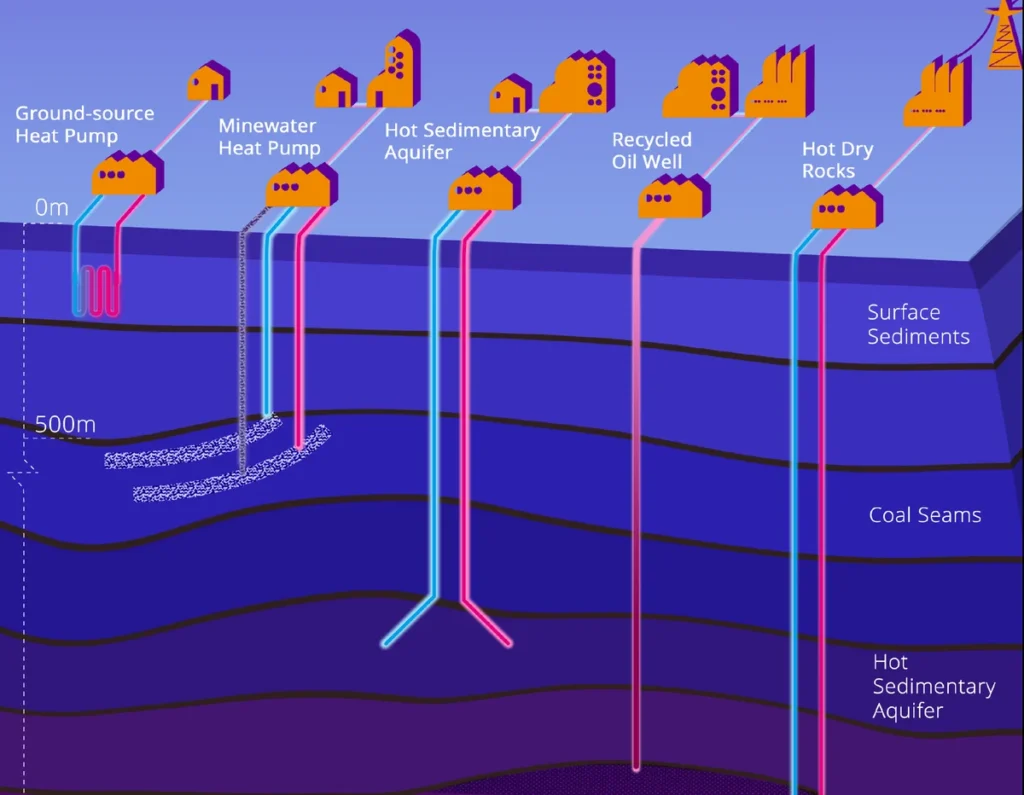
Geothermal Energy is often misunderstood by people who do not have a background in geoscience, and for good reason! The term which refers in general to thermal energy from the ground covers a wide array of different resource types. This diagram illustrates the different types of geothermal resource found in the UK and most other countries.
As an independent consultancy, TownRock consider all types of geothermal (and other low carbon) technologies to meet the needs of our clients. In brief, these fall into shallow ground-source systems, mine water systems, and deep geothermal. A low-carbon counterfactual, such as air-source, is always compared so the client knows they are choosing the best solution.
Ground-Source Heat Pump
A ground-source heat pump extracts primarily solar thermal energy, and some geothermal energy, from the very shallow surface. Systems can be closed loop (pumping fluid through buried pipes) or open loop (pumping water through porous rocks via a production and injection well).
A closed-loop ground source system will typically consist of a collection (“array”) of vertical boreholes. The number of boreholes, their depth and optimal arrangement will be informed by the rock properties and the heating (and cooling) demand.
Surface-Water Heat Pump
Bodies of water on the surface, including lakes, rivers and even the ocean, can be great sources of renewable heating and cooling.
Minewater
Abandoned coal mines in Scotland’s central belt and across large areas of England and Wales are full of warm water. These legacies of the fossil fuel age can be recycled into vast sources of low-carbon heating and cooling at relatively low cost. Heat exchangers and heat pumps are usually used to elevate the temperature of the water to be delivered to the customer.

Aquifers
Aquifers are rocks with pore-spaces and natural fractures that exist across much of the UK generally, and in particular can overlap with onshore oil fields. Geothermal aquifers are often referred to as Hot Sedimentary Aquifers (HSAs).
Granites
Heat from radiothermal granites in the highlands of Scotland, the north east of England, and Cornwall can be converted into electricity by the use of Engineered Geothermal System (EGS) technology, with lots of heat as a useful by-product. This is often referred to as Hot Dry Rock geothermal, which targets naturally occurring fractures.
Disused Oil Well
When oil and gas wells are near the end of their economic life, they often produce large quantities of hot water. When local heat demand exists, or if a business which requires low cost heat (such as a heated greenhouse operator) wants to invest locally, the oil well can be given low-carbon geothermal afterlife.
CCG Well
TownRock Energy’s Cyclic Circulating Geothermal (CCG) well produces warm water and injects cold water via the same well, and can be deployed in any geology. This is an effective technological mitigation option when an aquifer or granite production/injection well encounters low flow.

Where are geothermal resources available?
Ground-source heat pumps can be installed nearly everywhere in the UK. This map highlights the areas of greatest geothermal energy potential. Aquifer and minewater resources are found in the sedimentary basins and granite ‘Hot Dry Rock’ resources are found in the granite batholiths.
What is the temperature at 1 km depth?
The flow of heat from deep underground to the surface of the planet also varies from place to place, which in turn affects the temperature of the rocks. Extensive datasets have been collected from boreholes, wells and mines, and this dataset has been interpreted across the UK, showing the temperature at 1 km depth.
How does our process work?
We work with a diverse and wide array of clients, so our services are customised to fit each client’s needs. However, we apply a consistent approach to our site evaluations in a phased process that minimises risk and maximises the client’s return on their investment.
Scope
Assesses all renewable heating and cooling technologies for a client’s location and energy demands, then compares them to identify the best solution.
Discover
Develops the detailed technology design, cost and business case, including permitting timelines and funding options.
Prove
Proves the technology’s commercial viability through exploratory subsurface data collection.
Enable
Moves the project toward delivery by exploring funding models and opportunities.
Deliver
Delivers the technology through procurement, construction and commissioning.
Operate
Operates the technology to ensure value generation, regulatory compliance, and low operational cost across the full lifecycle.
There is substantial grant funding support available to projects using highly innovative and low carbon technology.
The estimated carbon footprint for geothermal energy is over 90% less than an average gas boiler
210–380gCO2eq/kWh
Estimated footprint for a gas boiler
2 to 30 gCO2eq/kWh
Estimated footprint for geothermal
If you’re looking to reduce your carbon footprint and eliminate your reliance on fossil fuel, geothermal energy is a substantial, economic and future-proofed way to do it.
“Throughout the project I was impressed with the professionalism and quality of the work that TownRock Energy produced and even more so by the dedication and commitment the team demonstrated, really going ‘the extra mile’.”
Euan Harrison
Senior Programme Manager, Mace Group Limited
“TownRock Energy have certainly made their mark on the nascent geothermal industry in Scotland, and I am sure they will play a significant part in getting this industry to where it needs to be”
Hugh Barron
Business Manager, British Geological Survey
“I have much enjoyed working with TownRock Energy and hope to continue to do so. They are very knowledgeable, enthusiastic and professional, and the work they have completed has been to a high standard.”
Nicholas Poett
Scottish Farmer
What next?
If you are interested in exploring the geothermal potential of your site, contact us to arrange a site visit